The Hidden Exhaustion of Constantly Monitoring Yourself Have you ever found yourself constantly checking how you feel? Checking your breathing.
Checking your heart rate.
Checking whether you're anxious.
Checking whether you're confident enough.
Checking whether you're feeling sick.
Checking whether you might panic.
For many people with anxiety, this becomes so normal that they hardly notice they are doing it.
Yet it can be one of the most exhausting aspects of anxiety.
Many clients tell me they feel mentally drained all the time. They assume it is because of stress, work, family commitments or lack of sleep.
While those factors can certainly contribute, there is often another hidden source of exhaustion taking place throughout the day.
Their nervous system is constantly monitoring itself.
What Is Hypervigilance? Hypervigilance is a heightened state of awareness where the mind continuously scans for potential threats.
In the past, this response helped humans survive genuine dangers.
Today, however, the threats are often internal rather than external.
Instead of watching for predators, the anxious mind begins watching for:
Anxiety symptoms
Panic symptoms
Physical sensations
Emotional discomfort
Signs of illness
Social mistakes
Feelings of uncertainty
The mind becomes a full-time surveillance system.
Unfortunately, it never seems to switch off.
Why Anxiety Creates Self-Monitoring Anxiety is fundamentally a protective system.
Its job is to identify danger before danger becomes a problem.
The difficulty is that once anxiety becomes established, the brain can begin treating normal experiences as potential threats.
A slight increase in heart rate.
A sensation in the stomach.
A moment of dizziness.
A negative thought.
A feeling of self-consciousness.
The anxious mind immediately pays attention.
"What's that?"
"Is something wrong?"
"Should I be worried?"
The more attention given to these sensations, the more noticeable they become.
The Trap of Constant Checking Many people believe monitoring themselves is helping.
It feels responsible.
It feels sensible.
It feels like staying in control.
But there is a hidden cost.
Every time you check, your nervous system receives an important message:
"This must be important."
The brain then allocates even more attention to the issue.
The cycle becomes:
Notice a sensation.
Monitor it.
Feel concerned.
Monitor it even more.
Become increasingly aware of it.
Over time, the monitoring itself becomes part of the problem.
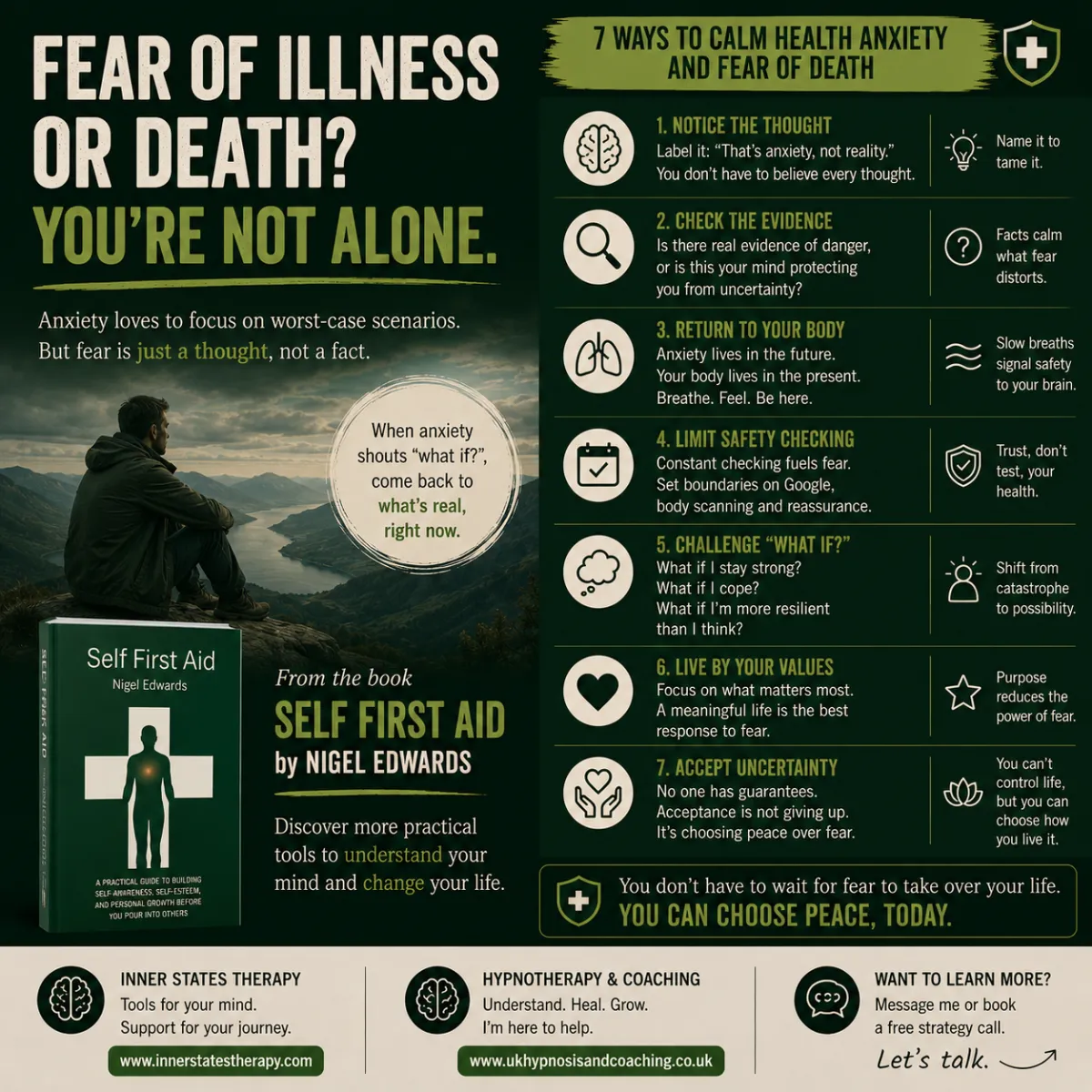
Health Anxiety and Body Scanning This pattern is particularly common in people experiencing health anxiety.
Many spend significant amounts of time:
The intention is understandable.
They are trying to feel safe.
Unfortunately, the brain often learns the opposite lesson.
If we keep checking, there must be danger.
This can strengthen anxiety rather than reduce it.
Learn more about health anxiety here:
https://www.ukhypnosisandcoaching.co.uk/health-anxiety
Social Anxiety and Self-Monitoring Hypervigilance is not limited to physical symptoms.
People with social anxiety often monitor themselves constantly during conversations.
They may check:
How they sound
How they look
Whether they seem nervous
What others think of them
Whether they said the right thing
This intense self-focus can make social situations feel exhausting.
It can also create the very awkwardness people are trying to avoid.
Learn more about social anxiety here:
https://www.ukhypnosisandcoaching.co.uk/social-anxiety
Emetophobia and Internal Awareness People struggling with emetophobia often become highly aware of:
The mind begins scanning continuously for signs of sickness.
This constant vigilance can make everyday life feel restrictive and exhausting.
Learn more about emetophobia here:
https://www.ukhypnosisandcoaching.co.uk/emetophobia
Why The Monitoring Becomes Exhausting Imagine carrying out a security check every few minutes throughout the day.
Checking every thought.
Checking every sensation.
Checking every emotion.
Checking every social interaction.
Most people would find that exhausting.
Yet many anxious individuals are doing exactly this without realising it.
Their minds are working overtime.
No wonder they feel tired.
How Hypnotherapy Can Help One of the goals of hypnotherapy is to reduce the perceived threat attached to thoughts, feelings and sensations.
When the nervous system no longer believes it must constantly monitor for danger, it can begin relaxing naturally.
This often leads to:
The aim is not to ignore life.
It is to stop treating every sensation, thought or emotion as a potential emergency.
The Freedom Many People Discover A surprising shift often happens during anxiety recovery.
People stop spending so much time monitoring themselves.
They become more present.
More engaged.
More focused on living rather than analysing.
Life begins feeling lighter.
Not because every anxious thought has disappeared, but because those thoughts no longer demand constant attention.
Related Support Pages Anxiety:https://www.ukhypnosisandcoaching.co.uk/anxiety
Health Anxiety:https://www.ukhypnosisandcoaching.co.uk/health-anxiety
Social Anxiety:https://www.ukhypnosisandcoaching.co.uk/social-anxiety
Panic Attacks:https://www.ukhypnosisandcoaching.co.uk/panic-attacks
Emetophobia:https://www.ukhypnosisandcoaching.co.uk/emetophobia
Free Strategy Call If anxiety, panic attacks, health anxiety or overthinking are affecting your life, you can arrange a free strategy call here:
https://www.ukhypnosisandcoaching.co.uk/booking
Inner States Therapy App The Inner States Therapy App helps people understand the different emotional parts involved in anxiety, self-protection and fear responses.
Using visual therapeutic tools, journaling resources and guided exercises, it helps develop greater awareness and emotional flexibility.
https://www.innerstatestherapy.com
Now with my new eBook: Self First Aid
The Hidden Exhaustion of Constantly Monitoring Yourself | Anxiety & Hypervigilance
 07538 789777
  nigel@ukhypnosisandcoaching.co.uk